Love to Dream lifts conversion by asking one question in the cart, powered by Giftnote
The Australian baby sleepwear brand moved the gift question out of checkout and into the cart drawer across five international stores, and A/B tested a 7% conversion rate increase on the way.
Industry
Baby & Kids
The Challenge
Love to Dream's sleepwear was already one of the most-gifted products in the baby category, but shoppers only found out the brand could handle a gift at checkout, once the basket was already fixed.
The Solution
A permanent Gifts destination, 36 curated gift sets, and a gift prompt built into the cart drawer itself, so shoppers are told the purchase makes a good gift while they can still act on it. Built on Giftnote across five Shopify Plus stores.
SYDNEY: Love to Dream, the Australian baby sleepwear brand whose zip-up swaddles are a fixture of new-parent gift lists worldwide, has built gifting into the core of its storefront across five international markets, and has the conversion data to show it was worth doing.
The programme is powered by Giftnote, the gifting platform used by more than a thousand Shopify brands, and runs across Love to Dream's Australian, United States, United Kingdom, Canadian and European Shopify Plus stores.
The most-gifted product in the nursery
Love to Dream built its name on a single idea executed properly: a swaddle with the baby's arms up, in the natural position babies sleep in. The Swaddle Up became a category standard, and the range grew around the sleep journey: Stage 1 swaddles, Stage 2 transition bags with removable wings, Stage 3 sleep suits and sleep bags, graded by TOG rating for the temperature of the room.
That product line has an unusual property. Almost nobody buying it for the first time is buying it for themselves. Baby showers, birth announcements, first Christmases and hand-me-down upgrades between friends are the natural buying occasions, and the person paying is very often not the person the parcel is for.
The brand's own gifting headline puts it plainly: Give the Gift of Sleep.
The range, priced as gifts
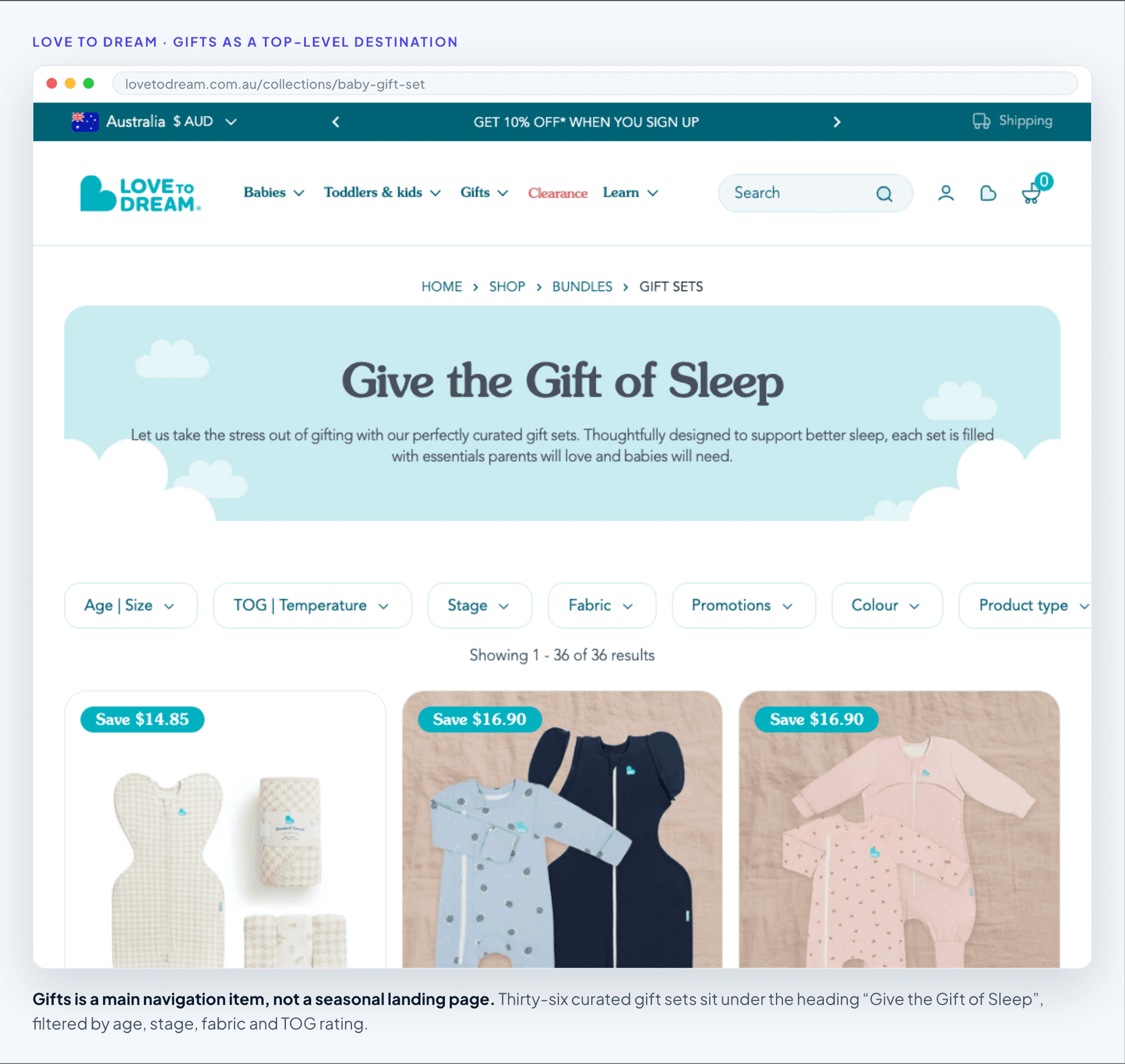
Gifts is a permanent item in Love to Dream's main navigation, not a seasonal landing page, and it leads to 36 curated gift sets filtered by age, stage, fabric, colour and TOG rating.
The ladder runs from an entry gift to a full nursery set:
- Baby Bath Bundle: hooded towel and wash cloth, from $47.92
- Swaddle Up™ 1.0 TOG in cotton or viscose from bamboo, $49.95–$54.95
- Swaddle Up™ 2-in-1 Transition Bag, $59.95
- Newborn Gift Bundle: Swaddle Up, hooded towel and wash cloths, $95
- Newborn Essential Miffy Gift Bundle, $130
- Sleep Suit Miffy Gift Bundle, $150
- Sleep Suit Sleep Machine Bundle, $175
- Newborn Ultimate Gift Bundle: sleepwear, toy and dummies, $200
Bundling matters more in this category than most. A gift-giver who doesn't know a baby's size or the temperature of the nursery will reach for a set that has been assembled for them, and will spend more doing it.
The question that moved
The part of Love to Dream's programme worth studying is where the gift conversation happens.
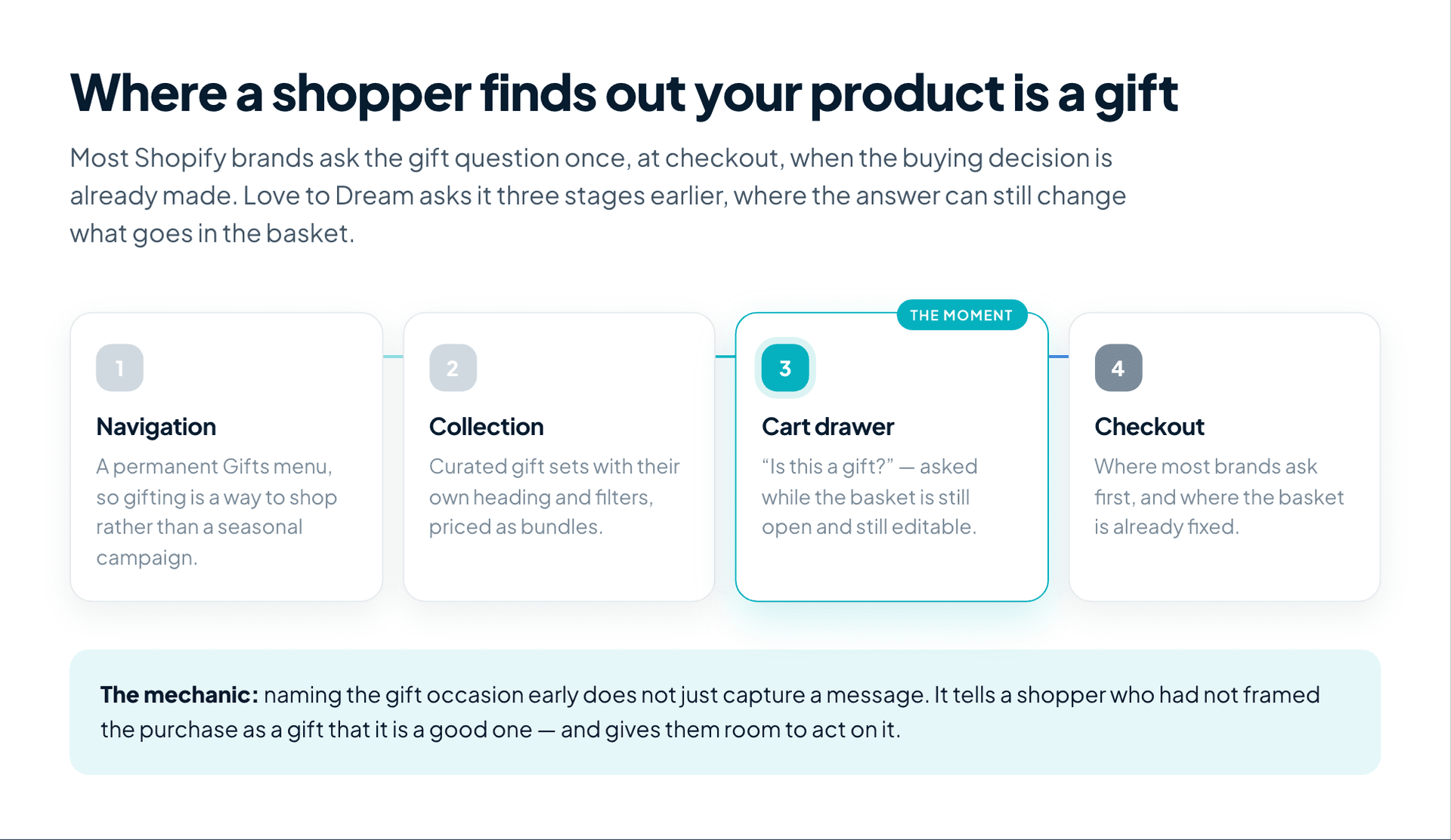
On most Shopify stores, the first time a shopper learns that a brand can handle a gift is at checkout: a message field below the shipping address, offered at the moment the basket is already fixed and the decision already made.
It captures a message from people who had already decided to send a gift. It doesn't create any.
Love to Dream moved the question upstream, into the cart drawer. Open the basket and the prompt sits directly above the checkout button: Is this a gift? Expanding it offers a free gift message for the recipient, and an optional gift box for $7.95 in Australia and $5.95 in the United States.
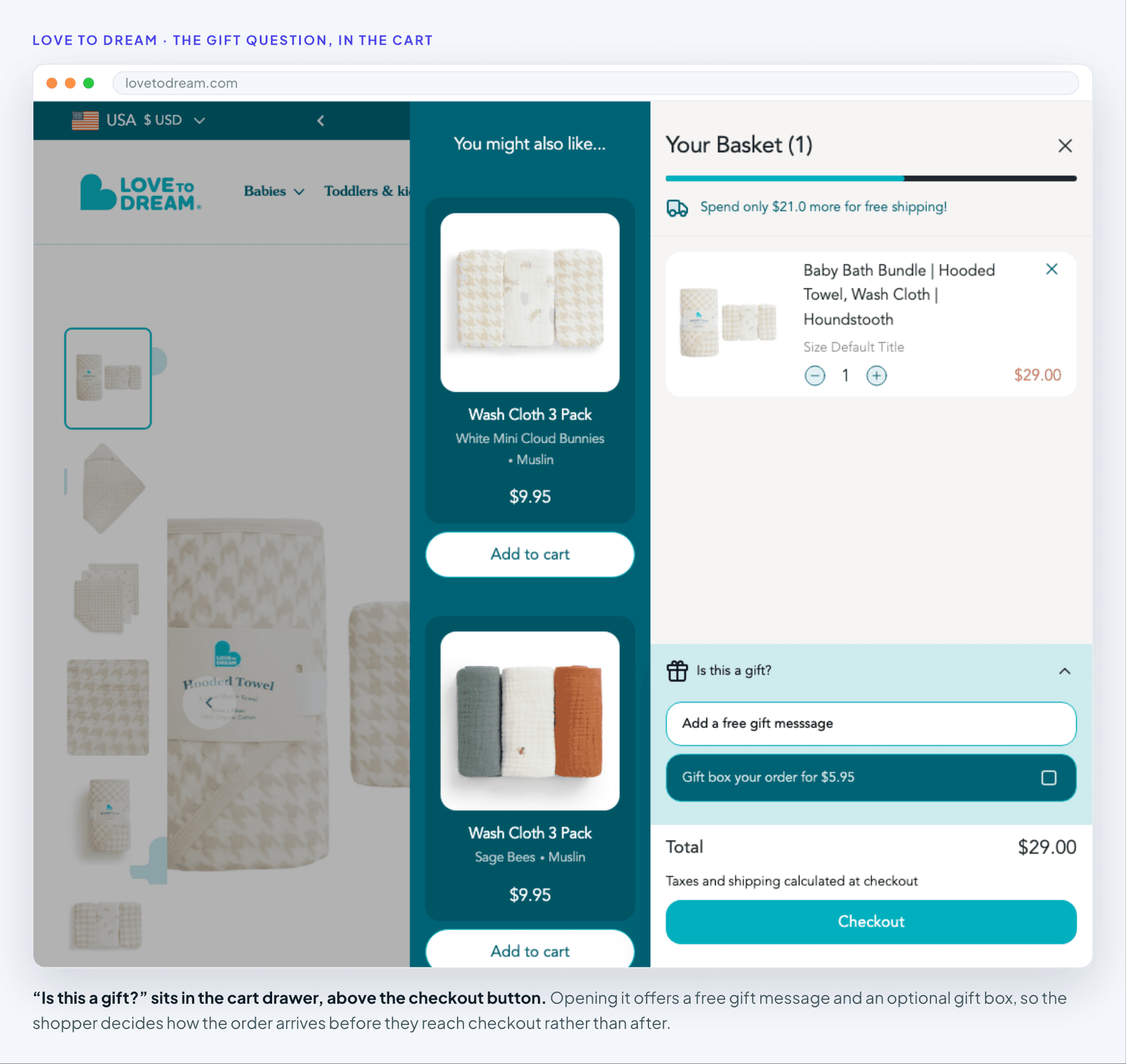
The wording is doing more work than it looks. A shopper who came to buy a swaddle for their own baby is unaffected. A shopper buying one for their sister's baby hadn't yet thought of it as a gift. Now they're told, at exactly the right moment, that this brand does gifts properly: the presentation, the timing and the message.
Giftnote POV
Telling a customer your product makes a good gift is a conversion tactic, not a merchandising one. The gift message field is the visible part. The signal it sends, this brand will handle the occasion for you, is what changes the outcome.
What the A/B test showed
Love to Dream ran the change as a proper experiment rather than a rollout, testing the gift note button in the cart on its United States store over several weeks.
The test variation returned a 7% increase in conversion rate, which the brand reported at 92% statistical significance with a consistent trend. Head of Digital Lou Simpson shared the result directly:
There's so much opportunity in gifting and we really are only just scratching the surface.
The brand made the placement permanent across its three largest markets, and reported a significant increase in gift messages across all three in the weeks that followed.
Two things are worth separating. The lift is on store conversion rate, not on gift attach rate. More people completed a purchase, not merely more people added a message.
And the change tested was placement, not product. The same capability sitting at checkout had been available the whole time.
Why gifting compounds in the baby category
Gifting compounds in baby and kids for a structural reason rather than a seasonal one.
A gift in this category arrives at a moment of high emotional stakes, in front of a recipient who is about to spend the next three years buying the same category repeatedly, in sizes that change every few months. A swaddle gifted at 0–3 months is a transition bag purchase at six months and a sleep suit purchase at twelve.
Through Giftnote's Klaviyo integration, those recipients sync to the brand's Klaviyo as an identifiable audience, separate from customers who bought for themselves, and can opt in to hear more. That is the difference between a gift being a transaction and a gift being an introduction.
What Love to Dream's programme shows
- The gift question belongs where the basket can still change, not at checkout where it's already fixed.
- Making Gifts a permanent navigation destination signals the occasion before the shopper reaches the cart.
- Curated bundles let a gift-giver who doesn't know the size or the room temperature buy with confidence, at a higher order value.
- Test placement before assuming the capability is the problem. The same feature moved earlier in the funnel behaved differently.
About Love to Dream
Love to Dream is an Australian baby sleepwear brand best known for the Swaddle Up™, the arms-up swaddle designed for the position babies naturally sleep in. Its range spans swaddles, transition bags, sleep suits, sleep bags, layers and nursery essentials, graded by stage and TOG rating, and sells through Shopify Plus stores in Australia, the United States, the United Kingdom, Canada and Europe.
About Giftnote
Giftnote is the gifting layer for Shopify. Over a thousand brands use it for branded gift messages, digital gift cards, store credit and multi-recipient corporate gifting, with every recipient captured as a contact rather than a shipping address.
Move the gift question earlier in your funnel
Book a personalized demo, or install Giftnote on your Shopify store and run a free Gift Audit.
Frequently asked questions
Does telling customers a product is a good gift increase conversion rate?
Love to Dream A/B tested exactly this, adding a gift prompt to the cart on its United States store, and reported a 7% increase in conversion rate for the test variation at 92% statistical significance. The mechanism is that shoppers who had not framed a purchase as a gift are told, while the basket is still editable, that the brand will handle the occasion.
Where should a gift message option go on a Shopify store?
The cart is generally stronger than checkout. Checkout captures messages from people who had already decided to send a gift; the cart reaches shoppers who haven't made that decision yet and can still change what they buy. Brands running gifting as a channel typically place it in the cart drawer, on product pages, and at checkout.
What is the best gift for a baby shower?
Bundled sleepwear tends to outperform single items, because the person buying rarely knows the baby's size or the temperature of the nursery. Love to Dream's gift sets run from a bath bundle around $48 to a full newborn set at $200, filtered by stage and TOG rating.
How do you add a gift message to a Shopify order?
Shopify has no built-in gift message field. Brands add one with an app. Love to Dream uses Giftnote, which places the gift option in the cart and delivers the message to the recipient by email or SMS as a branded page rather than a line on a packing slip.
Can a Shopify brand run gifting across multiple countries?
Yes. Love to Dream runs Giftnote across five Shopify Plus stores covering Australia, the United States, the United Kingdom, Canada and Europe, with recipient messaging configured per market.
What is the best gifting app for a Shopify baby brand?
Look for gift messaging that can sit in the cart rather than only at checkout, scheduled delivery so a gift arrives on the right day, recipient data flowing into your email platform, and multi-store support if you sell across markets. Giftnote provides all four and is used by baby brands including Love to Dream and Nestig.
Related Success Stories
See how other brands are transforming their gifting experience
OTTWAY launches local-currency gift cards across Shopify Markets, powered by Giftnote
The Melbourne unisex label, now issues its gift vouchers in each international customer's own currency, alongside gift messages on every physical order.
Read story →
Kirstin Ash launches local-currency gift cards across Shopify Markets, powered by Giftnote
The Sydney jewellery brand has unified its regional stores on Shopify Markets and its gifting programme, with local-currency gift cards and gifter and recipient profiles split in Klaviyo.
Read story →
Ballerina Farm opens corporate gifting with a published three-step process
Ballerina Farm has opened a corporate gifting storefront, sending to a full recipient list from one order with a personal message for every recipient and a send date the buyer chooses.
Read story →
 Automated giftingPaperless & brandedNew revenue stream
Ready to write your success story?
See how Giftnote can transform your gifting experience.
Multiply Your Revenue Through Gifting