Before you plan this peak, audit your last one
Discover the four gifting metrics every Shopify brand should know before Black Friday. Learn how to uncover hidden gifting revenue, identify missed opportunities and use last year’s order data to build a smarter holiday strategy with Giftnote’s free Gift Audit.
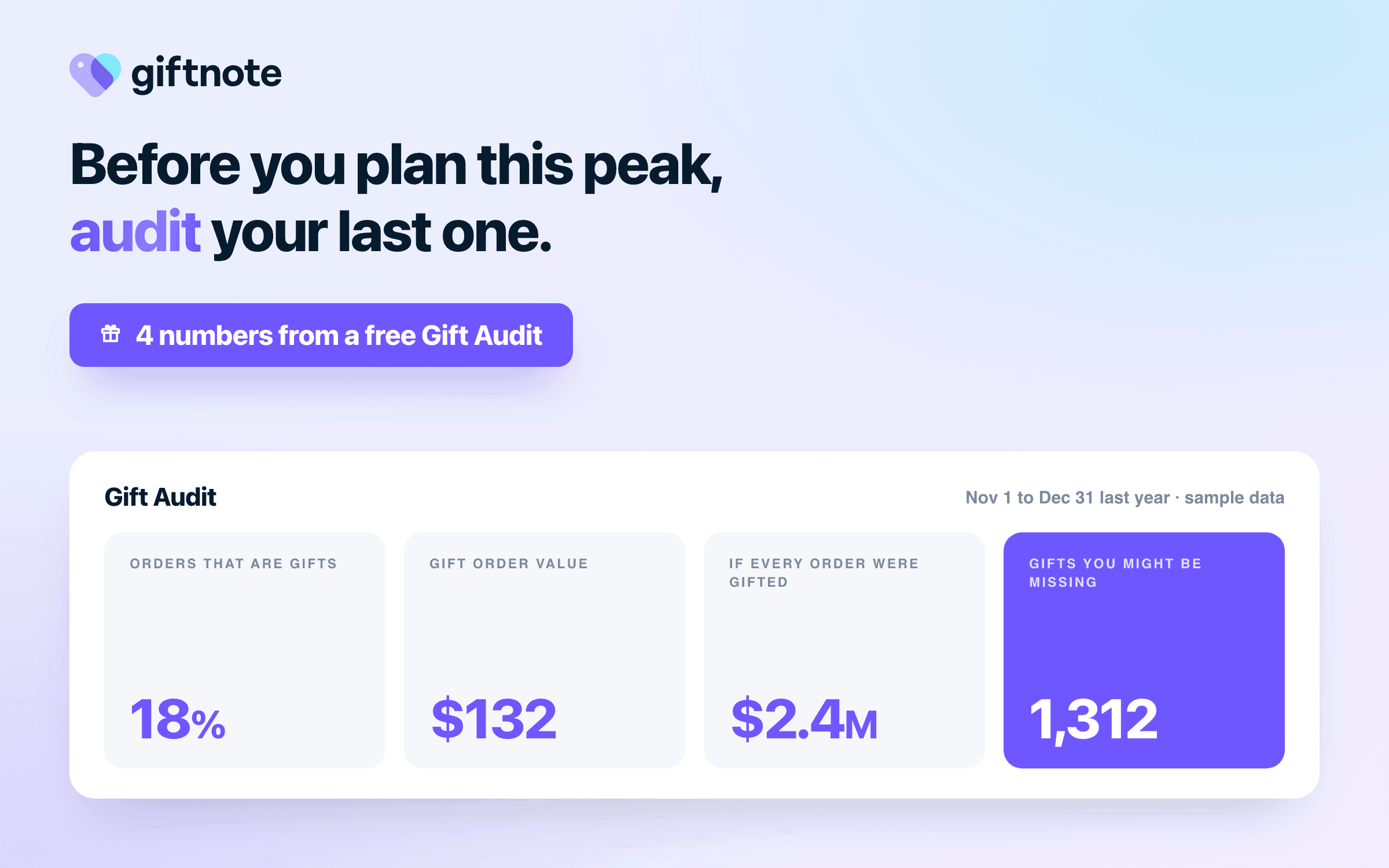
4 Numbers That Should Shape Your Holiday Gifting
How much of last December's revenue was gifted? Which products did people buy for someone else? How many of those gifts arrived in a plain box, with no message and no way for the gift recipient to know who sent it, or who you are?
Most Shopify stores cannot answer any of those questions. Yet they are about to plan stock, gift guides and Black Friday campaigns for the busiest gifting weeks of the year.
The good news is that the answers are already sitting in your order history. You just need to read it before you plan, not after.
Why last year's orders are the best peak plan you have
Giftnote POV
Peak gifting is concentrated and predictable. December is the biggest gifting month of the year across Giftnote stores, and the same occasions drive the same spikes every year, and the products people gift tend to repeat.
That makes last year's holiday orders the most useful planning document you own. They tell you how big gifting really is for your store, what it is worth, and how much of it you missed. Plans built on that data beat plans built on a hunch about "holiday shoppers."
The catch: Shopify does not label gift orders. Unless someone ticked a box, a gift looks exactly like any other order. That is the gap a gift audit closes.
What is a gift audit?
A gift audit is an analysis of your past orders that identifies which ones were gifts, what they were worth compared with other orders, and how many gifts went out without a message.
Giftnote's free Gift Audit does this automatically. Pick a date range, and it reads your Shopify orders using patterns learned from more than 680,000 gifts, such as a shipping address that does not match the purchaser. There is no tagging, no checkout change, and no setup.
Pro Tip
For peak planning, run it on last year's holiday window: November 1 to December 31. Then use the four numbers it gives you.
Number 1: How many of your orders are gifts
Your gift share is the percentage of orders that were bought for someone else.
What it changes before peak:
How much of your holiday plan should speak to gifters. If 30% of your December orders were gifts, but your Black Friday emails all talk to people buying for themselves, a third of your best customers are reading the wrong message.
Use your gift share to decide how many campaigns, landing pages and ad sets should carry a gifting message this year.
Number 2: What a gift order is worth
Gift order value compares your average gift order with your other orders. Across Giftnote stores, gift orders are worth 25% more on average.
What it changes before peak:
Your gift guide price points and bundles. If your gift orders run well above your store average, gifters are telling you they will spend more when the order is for someone else. Build gift sets and "under $X" collections around the price your gifters actually pay, not your store average.
Number 3: What your store could earn from gifting
Potential sales shows what your revenue would look like if more of your orders were gifts, using your own gift order value.
What it changes before peak:
The size of the prize. This is the number to take to whoever owns the marketing budget. It turns "we should do more for gifting" into a revenue figure, which makes it much easier to justify a gift guide, a gifting landing page, or a better gifting experience before the rush.
Number 4: How many gifts you missed
The missed-gift scan flags orders that look like gifts but never went through a gifting flow: no message, no notification, and no record of who the gift recipient was.
What it changes before peak:
Everything else. Each missed gift is a gift recipient who opened a box from a brand they may not know. 74% of gift recipients have never bought from the brand before. Without a message or a way to opt in, that introduction disappears.
Peak makes this more expensive.
Giftnote POV
Across Giftnote stores, about 1 in 10 gift recipients (11%) goes on to buy from the store within 90 days, but gifts sent in November and December 2025 converted 17 to 19% of gift recipients, roughly double the rest of the year. Your missed holiday gifts are the most valuable introductions you will lose all year.
If the scan finds a large number of missed gifts, your first priority before Black Friday is a gifting experience that reaches the gift recipient: a message they actually receive, timed to arrive with the gift, and a reason to come back.
What to do with your audit in the next five weeks
Black Friday is November 27. Here is how to turn the audit into a plan:
- This week: run the Gift Audit on November 1 to December 31 last year. Note your four numbers.
- Next week: use your gift share and gift order value to set gifting's share of your campaign calendar, and to price gift guides and bundles.
- Before November: fix the gap the missed-gift scan found. Give gifters a way to add a message, and make sure it reaches the gift recipient.
- Before Black Friday: run the audit again on a recent two-week window to check that gifts are now being captured.
- In January: run it on this year's holiday window and compare.
Already on Giftnote? Open last year's BFCM report
If you already use Giftnote, you can go one level deeper. Your audit numbers are in Analytics, under Gift value uplift. Next to them, Moments gives every gifting occasion its own report: Valentine's Day, Mother's Day, Father's Day, Black Friday to Cyber Monday, Christmas and more.
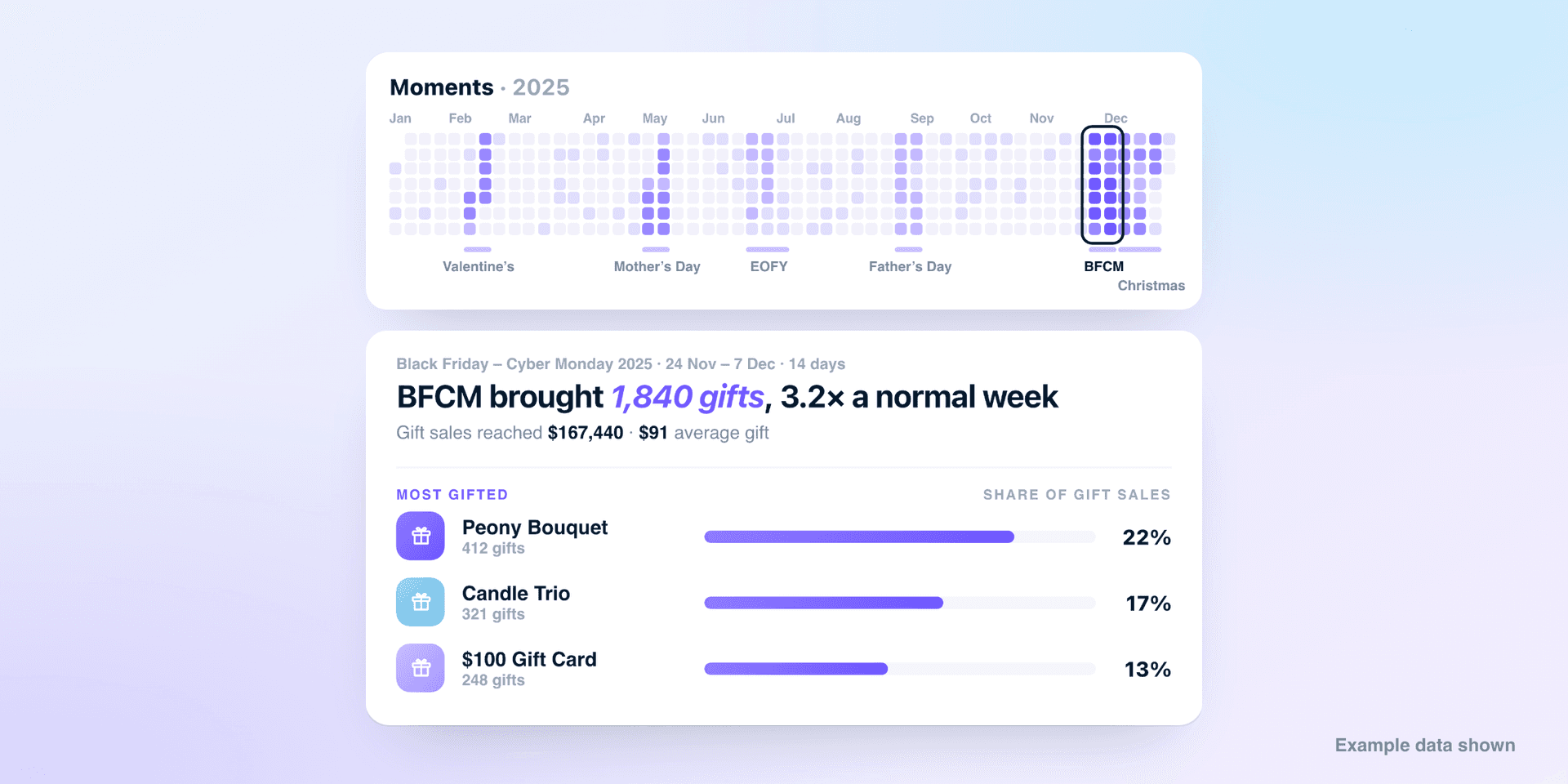
The audit tells you how much gifting your store has. A Moment report tells you what happened during one occasion:
- How big it was: total gifts, gift sales and average gift, compared with a normal week.
- When it peaked: a day-by-day view against a typical day, so you know which dates need stock, staff and campaigns.
- What sold: your most-gifted products and their share of gift sales.
- What changed: the shifts that only show up at peak, such as a jump in gift cards, scheduled gifts or Multi-Gift portal orders.
- Who came back: how many gift recipients from that moment have bought from you since.
Open last year's BFCM report before you plan this one. If gift cards took a much bigger share than usual, put them in your Black Friday emails. If scheduled gifts spiked, make sure Send Later is switched on. If one product carried a fifth of your gift sales, stock it deep.
This year's report will build as your orders come in, so you can watch BFCM 2026 day by day and compare it with last year in January.
Run your free Gift Audit
Gift Audit is free, reads the orders you already have, and gives you your four numbers in minutes. If you decide to add gift messages and gift cards later, your data comes with you, along with a report for every gifting moment.
Want help acting on your numbers before Black Friday? Our team offers white-glove peak setup.